


Sustainability in every piece
At Schogetten, we attach great importance to sustainability. This includes everything to do with the little chocolate pieces: climate protection, packaging, recyclability, raw materials, and social responsibility. Sustainability has been a priority at Schogetten for many years, and it is a challenge that we are happy to face head-on. We explain here how far we have come and which goals we are still aiming to achieve.
Would you like to learn more about our commitment to sustainability? Discover more here:


Schogetten and
climate protection
If we want to combat climate change, we must reduce CO2 emissions worldwide. The first important step toward this is to reduce energy consumption, which we are achieving at some of our plants by means of an energy management system, among other strategies. At several plants, we have also switched to 100% green electricity and use an efficient combined heat and power system. These initiatives contribute to the company’s long-term goal of achieving climate-neutral status. Since 2020, we have been balancing our climate impact throughout the KRÜGER GROUP in accordance with the Greenhouse Gas (GHG) Protocol. For accounting years 2020 and 2021, this included GHG scope 1 and scope 2. Since the beginning of accounting year 2022, it has additionally encompassed scope 3.
If we want to combat climate change, we must reduce CO2 emissions worldwide. The first important step toward this is to reduce energy consumption, which we are achieving at some of our plants by means of an energy management system, among other strategies. At several plants, we have also switched to 100% green electricity and use an efficient combined heat and power system. These initiatives contribute to the company’s long-term goal of achieving climate-neutral status. Since 2020, we have been balancing our climate impact throughout the KRÜGER GROUP in accordance with the Greenhouse Gas (GHG) Protocol. For accounting years 2020 and 2021, this included GHG scope 1 and scope 2. Since the beginning of accounting year 2022, it has additionally encompassed scope 3.

Schogetten—packaging and recyclability
The environment can be further protected by using fewer resources, preventing the overexploitation of nature, avoiding waste, and making sure that packaging is easily recyclable. To fulfill these criteria, the classic 100 g Schogetten pack uses materials that are 86%–91% recyclable*.
The environment can be further protected by using fewer resources, preventing the overexploitation of nature, avoiding waste, and making sure that packaging is easily recyclable. To fulfill these criteria, the classic 100 g Schogetten pack uses materials that are 86%–91% recyclable*.
* applies to the EU, Switzerland, Norway, and the UK
* applies to the EU, Switzerland, Norway, and the UK

Schogetten—raw materials
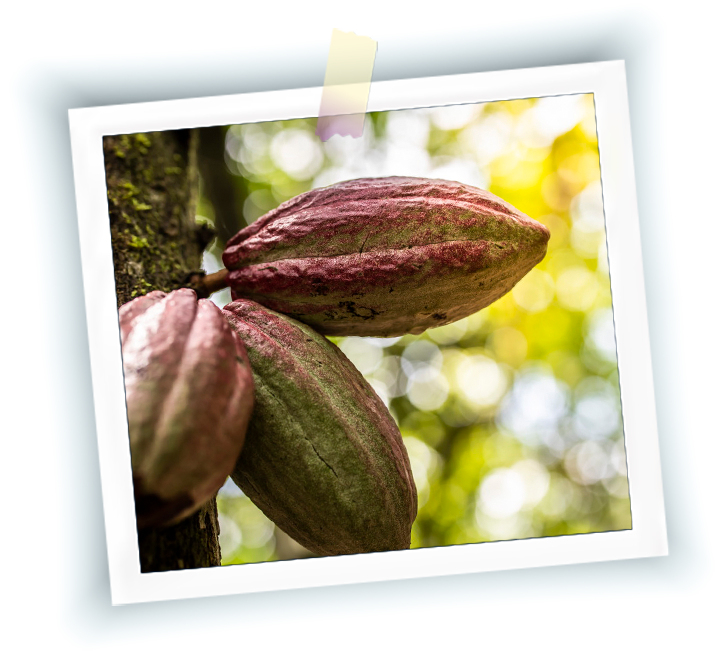
How can cocoa farmers become dedicated rainforest and environmental protectors? One answer is by making it financially worthwhile. We take responsibility for and contribute to improving the living conditions of people in cocoa-growing countries, in addition to our initiatives aimed at protecting nature. We are committed to cocoa, and the Schogetten brand acts on this as a partner of cocoa commitment, the KRÜGER GROUP’s cocoa sustainability program.
In cases we use palm oil, we only use 100% certified palm oil from sustainable cultivation. This is particularly important to us.
How can cocoa farmers become dedicated rainforest and environmental protectors? One answer is by making it financially worthwhile. We take responsibility for and contribute to improving the living conditions of people in cocoa-growing countries, in addition to our initiatives aimed at protecting nature. We are committed to cocoa, and the Schogetten brand acts on this as a partner of cocoa commitment, the KRÜGER GROUP’s cocoa sustainability program.
In cases we use palm oil, we only use 100% certified palm oil from sustainable cultivation. This is particularly important to us.

The whole is greater than the sum of its parts
Each small component is significant in and of itself, but cumulatively these components gain even greater importance. What is the point of climate-friendly packaging if it is not easily recyclable? What is the point of environmentally friendly cocoa cultivation if human rights are violated in the process? This is precisely why we at Schogetten are striving to become ever more sustainable in all areas.

Why is sustainability so important?
We want future generations to be able to enjoy Schogetten too. That is why we are dedicated to both nature and people, and therefore the climate. As we are a family business, future generations always play a part in our planning. This applies not only to the people who make Schogetten, but also to those who grow the cocoa and even those who have nothing to do with Schogetten—because we only have one earth. This is our motivation to keep the environment a priority in our decision-making, and to create living and working conditions in which people can thrive.
The whole is greater
than the sum of its parts
Each small component is significant in and of itself, but cumulatively these components gain even greater importance. What is the point of climate-friendly packaging if it is not easily recyclable? What is the point of environmentally friendly cocoa cultivation if human rights are violated in the process? This is precisely why we at Schogetten are striving to become ever more sustainable in all areas.
Why is sustainability
so important?
We want future generations to be able to enjoy Schogetten too. That is why we are dedicated to both nature and people, and therefore the climate. As we are a family business, future generations always play a part in our planning. This applies not only to the people who make Schogetten, but also to those who grow the cocoa and even those who have nothing to do with Schogetten—because we only have one earth. This is our motivation to keep the environment a priority in our decision-making, and to create living and working conditions in which people can thrive.